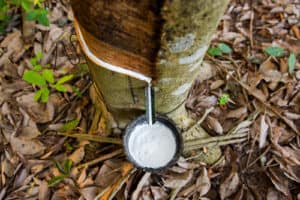
The Global Platform for Sustainable Natural Rubber (GPSNR) recognizes the valuable contributions women make to the natural rubber industry and affirms its commitment to fostering an inclusive and sustainable sector. We believe that all individuals, regardless of gender, should have equal opportunities to participate in and benefit from the sector.
As part of this commitment, GPSNR has prioritized gender inclusivity in its capacity-building initiatives, ensuring that women benefit from our projects. To date, 43.49% of the 14,000 smallholders who benefitted through GPSNR’s initiatives are women. We will continue to integrate and prioritize gender inclusivity Key Performance Indicators (KPIs) in relevant sustainability initiatives, ensuring that women have equal representation and access to opportunities. These efforts will help create an environment where all participants can contribute to and benefit from the growth of the sector.
GPSNR is committed to advancing social sustainability alongside environmental goals, recognizing that the well-being of all stakeholders is essential for long-term success in the rubber industry. By supporting gender inclusivity, GPSNR seeks to contribute to a more equitable and sustainable future for the entire natural rubber value chain.
In February 2022, the Global Platform for Sustainable Natural Rubber released its Theory of Change (ToC), a document which articulates how the platform aims to positively impact the supply chain and achieve its desired states. As a representative of my company Michelin at the platform, I have been part of this intensive, fulfilling task for the last year.
While I had some previous experience with ToC frameworks for individual projects, this was the first time I was engaged in one at a multi stakeholder platform level. The major difference here, and one emblematic of the ‘GPSNR multi-stakeholder experience’, was that we needed to integrate as many perspectives and expertise as we could, from all of GPSNR’s working groups and member categories. After all, bringing this theory of change to life is a task that will eventually fall on every stakeholder represented in GPSNR. If we wanted a document that the platform could truly rally around, we needed a co-creation process built on inclusivity as well as accountability.
My fellow task team members Martin Hollands (BirdLife International) and James Laimos (Goodyear) can attest to the fact that the journey was hard work. Yet, over the two half-day platform workshops and numerous additional consultation sessions with working group chairs and interested members, the strength of the platform showed itself in the depth of insights provided during discussions, and in the rigor of the final document. I am confident we would not have arrived where we did without the unique mix of experiences and operating contexts that members had. As a representative of my organization, the exposure to a wide range of perspectives from all along the natural rubber value chain is also a valuable input to our own sustainability journey, alongside and in addition to GPSNR.
Image 1: A screenshot of me presenting how GPSNR’s Desired State will be aligned with our Theory of Change at a workshop in 2021
The most visible output of this work is this interactive web-document accessible on the GPSNR website. While it is an easy and simple introduction to our work, it is nonetheless a result of a rigorous and intensive process, which required the investment of many stakeholders (including many hours of hard deliberation by the task team!). This of course belies the question:
Does theory matter and was this time really worth it?
It’s a question the task team asked itself a number of times as well. However, my own journey in sustainability has taught me that while it is tempting to jump straight to action, issues on the ground are often more complex than they seem, and well-meaning actions can lead to unintended outcomes. We therefore not only need to know where we are going, but also need to map and understand the series of events or actions that will get us there. A theory of change exercise allows us to dig deep into the root causes of the current situation, leveraging on the experience and expertise we have across working groups and stakeholder categories to work on plans that tackle issues at their core.
Articulating the theory of change at this juncture in GPSNR’s journey also allows for a ‘stock take’ before the platform accelerates into implementation. The journey towards sustainability in the natural rubber supply chain is a complex one which requires a careful balance of environmental, social, and economic spheres. It also requires coordinating work on multiple action areas (i.e., the work of GPSNR’s many working groups) to make sure that our activities truly address identified root problems without any major gaps.
In fact, these conversations did end up identifying some gaps, and spurred us to explore solutions. For example, a member brought up the point that real impact across the world’s 6 million smallholders would mean that GPSNR would need some way to multiply its impact beyond farmers benefited through direct involvement in GPSNR or its capacity building programmes. Further conversation and the sharing of case studies from experiences in other commodities identified that a key intervention to tackle will be to empower networks of farmers that can promulgate good practices in, and beyond their communities.
As the world emerges from the aftermath of the pandemic and unprecedented supply chain disruptions, being clear on what we need to do to truly make an impact is more important than ever. I hope that interacting with GPSNR’s Theory of Change will give you a good idea of where we’re headed, and how we hope to get there!
Assurance Model Task Force: The Executive Committee (EC) has reviewed the Assurance Model documents and approved them to be submitted to the General Assembly for a vote. The EC has also identified several topics that will require further discussion and finalisation next year. These include minimum requirements, the mechanism for third-party oversight of assessor accreditation, the format and content of assessment result disclosures, the process for assigning third-party assessors, claims, refinements to the classification system for major non-conformities, and a risk-based approach to assessment scheduling. These topics will be presented for a vote at the 2025 General Assembly. For further context, here is the link to the compilation of feedback on the Assurance Model documents received since June, along with responses and changes made based on these comments: https://rubberplatform.sharepoint.com/:b:/s/GPSNRMembers/EWLmS86xDkxMtce9wKEuLjwByB6hU_QXrROu_XJ9DuK0kA?e=ZYYike
Additionally, the EC has agreed that the first three years of assessments (2027-2029) will be conducted annually, with mandatory public disclosure of a category-level summary of the assessments, while company-level disclosure will be optional for those being assessed.
Smallholders Representation and Capacity Building (SCB) Working Group: 18 members from Ghana were approved this month, with an onboarding call held on 10 October 2024. Additionally, the EC Election Campaign call for smallholders took place on 29 October 2024.
Koltiva submitted the final report for the Indonesia GAP Coaching Project (Phase 2) and delivered a final presentation on 17 October 2024. The third phase of the Indonesia GAP Coaching Project is now underway and is currently in the preparation stage. For the Thailand GAP Coaching Project, Koltiva presented the first full-year project results on 22 October 2024. Meanwhile, RAFs completed training for 1,000 farmers ahead of schedule in the Thailand Agroforestry Project. Furthermore, a curated content list and promotional poster for Rubber Wiki have been created to engage smallholders through the Knowledge Sharing Platform.
Looking ahead, a Pre-GA Webinar for smallholders is scheduled for 18 November 2024, and 10 new Cambodian smallholders have applied for membership and are awaiting approval.
For Capacity Building Projects, SCB WG members are requested to review and provide feedback on the final report for the Indonesia GAP Coaching Project (Phase 2) by 28 October 2024. Koltiva will also submit agricultural calendars and training materials for the third phase of this project for SCB WG review by the same date. For the Thailand GAP Coaching Project, Koltiva is revising the full-year review report based on feedback from SCB WG members. Additionally, the Project Management Subgroup will hold its kick-off meeting on 23 October 2024.
Shared Responsibility Working Group: The Shared Investment Panel (SIP) has officially been established following approval from the GPSNR Executive Committee.
The Secretariat is continuing to support the implementation of the Shared Investment Mechanism, with the Project Management Subgroup currently reviewing the proposals received. The SIP will select its co-chairs and plans to hold its kick-off meeting early next month.
Regarding the Value Transfer mechanism, the Executive Committee will form a task force with one representative from each ordinary member category. This task force will work on the next steps to finalise a revised proposal, with the aim to present it at the in-person meeting in February 2025.
GPSNR Secretariat
October 30, 2024
Scroll to Top
We use cookies on our website to give you the most relevant experience by remembering your preferences and repeat visits. By clicking “Accept”, you consent to the use of ALL the cookies. However you may visit Cookie Settings to provide a controlled consent.
This website uses cookies to improve your experience while you navigate through the website. Out of these cookies, the cookies that are categorized as necessary are stored on your browser as they are essential for the working of basic functionalities of the website. We also use third-party cookies that help us analyze and understand how you use this website. These cookies will be stored in your browser only with your consent. You also have the option to opt-out of these cookies. But opting out of some of these cookies may have an effect on your browsing experience.
Necessary cookies are absolutely essential for the website to function properly. These cookies ensure basic functionalities and security features of the website, anonymously.
Cookie
Duration
Description
cookielawinfo-checkbox-advertisement
1 year
Set by the GDPR Cookie Consent plugin, this cookie is used to record the user consent for the cookies in the "Advertisement" category .
cookielawinfo-checkbox-analytics
11 months
This cookie is set by GDPR Cookie Consent plugin. The cookie is used to store the user consent for the cookies in the category "Analytics".
cookielawinfo-checkbox-functional
11 months
The cookie is set by GDPR cookie consent to record the user consent for the cookies in the category "Functional".
cookielawinfo-checkbox-necessary
11 months
This cookie is set by GDPR Cookie Consent plugin. The cookies is used to store the user consent for the cookies in the category "Necessary".
cookielawinfo-checkbox-others
11 months
This cookie is set by GDPR Cookie Consent plugin. The cookie is used to store the user consent for the cookies in the category "Other.
cookielawinfo-checkbox-performance
11 months
This cookie is set by GDPR Cookie Consent plugin. The cookie is used to store the user consent for the cookies in the category "Performance".
PHPSESSID
session
This cookie is native to PHP applications. The cookie is used to store and identify a users' unique session ID for the purpose of managing user session on the website. The cookie is a session cookies and is deleted when all the browser windows are closed.
viewed_cookie_policy
11 months
The cookie is set by the GDPR Cookie Consent plugin and is used to store whether or not user has consented to the use of cookies. It does not store any personal data.
Functional cookies help to perform certain functionalities like sharing the content of the website on social media platforms, collect feedbacks, and other third-party features.
Performance cookies are used to understand and analyze the key performance indexes of the website which helps in delivering a better user experience for the visitors.
Cookie
Duration
Description
ac_enable_tracking
1 month
This cookie is set by Active Campaign to denote that traffic is enabled for the website.
Analytical cookies are used to understand how visitors interact with the website. These cookies help provide information on metrics the number of visitors, bounce rate, traffic source, etc.
Cookie
Duration
Description
_ga
2 years
The _ga cookie, installed by Google Analytics, calculates visitor, session and campaign data and also keeps track of site usage for the site's analytics report. The cookie stores information anonymously and assigns a randomly generated number to recognize unique visitors.
_gat_gtag_UA_139883466_1
1 minute
Set by Google to distinguish users.
_gid
1 day
Installed by Google Analytics, _gid cookie stores information on how visitors use a website, while also creating an analytics report of the website's performance. Some of the data that are collected include the number of visitors, their source, and the pages they visit anonymously.
CONSENT
2 years
YouTube sets this cookie via embedded youtube-videos and registers anonymous statistical data.
Advertisement cookies are used to provide visitors with relevant ads and marketing campaigns. These cookies track visitors across websites and collect information to provide customized ads.
Cookie
Duration
Description
NID
6 months
NID cookie, set by Google, is used for advertising purposes; to limit the number of times the user sees an ad, to mute unwanted ads, and to measure the effectiveness of ads.
VISITOR_INFO1_LIVE
5 months 27 days
A cookie set by YouTube to measure bandwidth that determines whether the user gets the new or old player interface.
YSC
session
YSC cookie is set by Youtube and is used to track the views of embedded videos on Youtube pages.