
RubberWay Contributes to Achieving GPSNR Goals

Share This Post

By Nicole Tan, Project Manager, RubberWay

A couple of months ago, RubberWay was proud to introduce its contributions to sustainable natural rubber to members of GPSNR. 

Data obtained through RubberWay contributes to helping users meet the GPSNR Reporting Requirements. A crosswalk analysis done by the RubberWay team showed that it provides 89% coverage of the 37 GPSNR Policy Components, of which 18 Policy Components are directly satisfied by RubberWay while 15 are partially contributed to.


RubberWay meets 33 out of 37 GPSNR Policy Components through direct and indirect contributions.


The webinar hosted by GPSNR gave RubberWay the chance to provide an overview of its solution from the perspective of both tire makers and processors. 

The sharing by tire makers highlighted the motivations for their participation in RubberWay and the ways in which RubberWay’s results have enabled them to engage in efforts on the ground. 

Similarly, natural rubber processors are able to apply data from RubberWay to implement field actions while also using the tool as a channel to facilitate communication directly with smallholders.
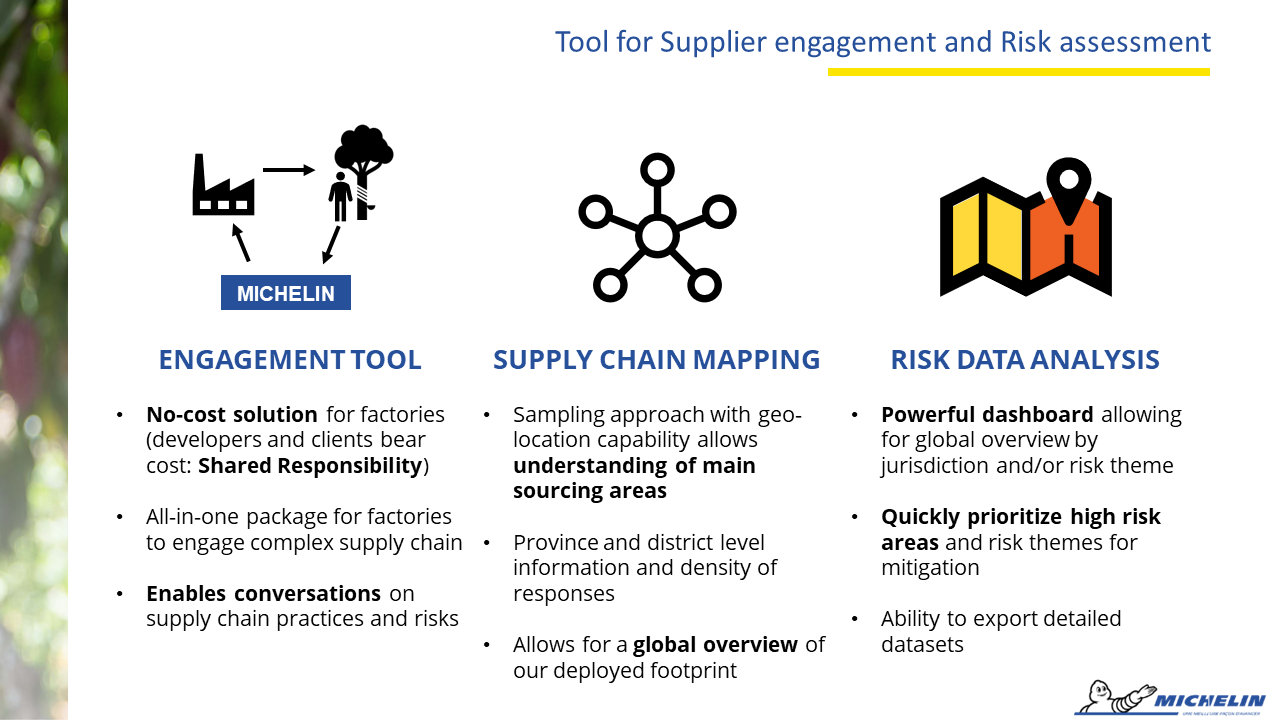
 

Users are able to utilise data generated through RubberWay to inform risk mitigation measures. RubberWay also provides its users with a channel for supplier engagement. 


More detailed information on how RubberWay contributes to achieving GPSNR’s goals for sustainable natural rubber can be found in the RubberWay white paper. Access to the complete crosswalk analysis is also available upon request.

ABOUT RUBBERWAY

RubberWay is a digital risk mapping solution that helps upstream actors to detect environmental and social risks across the natural rubber supply chain. Risk data obtained through RubberWay generates actionable insights for users like tire makers and processors to drive change towards sustainability within the industry. 

With over 50,000 questionnaires completed to date, the RubberWay dataset is set to increase with growing participation of users, enabling expansive reporting of sustainability risks across sourcing countries globally. 

Find out more about RubberWay here

More To Explore

News

Secretariat Update – August 2019

The signing of the MoU took place at IRSG’s Office in Singapore, on the 6 August 2019 by Mr Salvatore Pinizzotto, IRSG Secretary General and Mr Stefano Savi, GPSNR Director. The MoU will have the aim of consolidating, developing and detailing the cooperation between the two organisations. It will also contribute to the effectiveness to achieve the organisations’ common objectives in the field of sustainable production and consumption of natural rubber.

The cooperation will have a focus on Sustainability in the Natural Rubber Value Chain, particularly in relation to socio-economic and environmental aspects linked to the natural rubber sustainable production and consumption. Immediate opportunities for collaboration have been identified in the following areas: 

  1. Definition of Natural Rubber Sustainability and identification of appropriate standards, building on the activity carried out from IRSG in the SNR-i project.
  2. Natural Rubber Sustainability and socio-economic impacts on smallholders in producing countries.
  3. Land tenure right and sustainable income of smallholders in producing countries.
  4. Impact of climate change in rubber plantations and mitigation of risks.

The International Rubber Study Group (IRSG) was established in 1944 and is the only intergovernmental organization that brings the world’s rubber producing and consuming stakeholders together. The IRSG is the forum for the discussion of matters affecting the supply and demand for natural as well as synthetic rubber. IRSG is at the forefront in conducting activities and research on the sustainability of the natural rubber economy. IRSG has 36 member Governments and more than 700 industry members covering the whole natural rubber value chain.

The Global Platform for Sustainable Natural Rubber (GPSNR) is an international, multistakeholder, voluntary membership organization, with a mission to lead improvements in the socioeconomic and environmental performance of the natural rubber value chain. Development of the GPSNR was initiated by the CEOs of the World Business Council for Sustainable Development (WBCSD) Tire Industry Project (TIP) in November 2017. Currently the Platform has 51 Members including Producers, Processors & Traders, Tire makers and other rubber makers/buyers, Carmakers, other downstream users and Financial Institutions, and Civil society.

Representatives from each of these stakeholder groups have contributed to the development of the Singapore-based platform and the wide-reaching set of priorities that will define GPSNR strategy and objectives.

News

Addressing the Impact of COVID-19 on Natural Rubber Smallholders

Many are calling these “unprecedented times”, and undeniably so. The COVID-19 pandemic has brought the world many firsts – from the closing of international borders to country-wide lockdowns and quarantines, and extreme social distancing measures applied to everyday activities such as exercising and grocery shopping. In this sense, many of the impacts of COVID-19 have been unprecedented. 

‘Unprecedented’, however, does not necessarily translate into ‘unexpected’. This is especially true for a significant link of the natural rubber value chain: the millions of smallholders and farm workers that supply the world with around 85% of its natural rubber. These smallholders, seasonal workers and their families are some of the most vulnerable people within the natural rubber sector, living in poverty and without adequate access to social services. Poor diversification of farmers’ incomes means that farmers are solely dependent on tapping rubber trees to make a living. When a pandemic occurs and global demand for natural rubber falls, it comes as no surprise that smallholders are the hardest hit. 

The Equity sub-Working Group was formed to look into the issue of equity in the natural rubber value chain and to define what GPSNR’s role will be in promoting equity along the supply chain. It is chaired by Robert Meyer (Halcyon Agri) and co-chaired by Hendrike Braun-Issa (GIZ). The sub-Group has, in its first few calls, recognized the importance of addressing the impact that COVID-19 has on the supply chain, in particular the natural rubber smallholders. In view of this, discussions have been centered around producing a set of short-term recommendations to counter the impact of the COVID-19 crisis. These recommendations are particularly aimed at supporting small-scale natural rubber farmers and their families.

The International Rubber Study Group (IRSG), represented by Secretary-General Salvatore Pinizzotto, is also participating in the sub-Group discussions to provide advice in the area of cooperation with Governments. 

Along with the short-term recommendations, the sub-Group is also looking at long-term efforts to address the underlying systemic issues, and are carrying out a study to inform the Platform on the subjects of Living Wage and Living Income.

Improving the capacity and livelihoods of smallholders is just one of the strategies undertaken by GPSNR. It is equally important for the other players in the industry to advance GPSNR’s vision of a sustainable natural rubber value chain. The Policy Toolbox Working Group continues to finalize the proposed member policy requirements and reporting requirements, with consultation from all member categories. Meanwhile, the Traceability and Transparency Working Group is focused on acquiring a better understanding of tools to achieve greater traceability and transparency within supply chains. Both groups will be aligning on key issues such as supply chain risk assessment.

Scroll to Top