

Request For Proposal – GPSNR-RFP-A06-037 – Digital Knowledge Sharing Platform – Content Development

Share This Post

Introduction & Background


The Global Platform for Sustainable Natural Rubber (GPSNR) is an international multi-stakeholder, voluntary membership initiative seeking to lead improvements in the socioeconomic and environmental performance of the natural rubber value chain. Development of GPSNR was initiated by the CEOs of the World Business Council for Sustainable Development (WBCSD) Tire Industry Project (TIP) in 2019. Members of the platform include tire manufacturers, rubber suppliers and processors, vehicle makers and NGOs. Representatives from each of these stakeholder groups have contributed to the development of the Singapore-based platform and the wide-reaching set of priorities that define GPSNR strategy and objectives.

In 2021, GPSNR’s Capacity Building Working Group has identified that a digital knowledge sharing platform (KSP) is crucial to GPSNR’s future operations.  The GPSNR Secretariat and the GPSNR Capacity Building Working Group, through the GPSNR Knowledge Sharing Platform Task Force, are jointly overseeing the development and eventual operations and maintenance of a digital GPSNR Knowledge Sharing Platform called Rubber Wiki. 

Rubber Wiki will serve as a centralized digital hub, enabling smallholder rubber producers worldwide to access to technical information on relevant global news, latest sustainability best practices and Good Agricultural Practices, daily natural rubber prices, weather forecast and recommended activities, communication features and others. It will also facilitate peer-to-peer exchange of best practices, working conditions, and experiences, fostering coordination and collaboration within the global natural rubber production community.

GPSNR successfully completed the initial phase of the project, which involved conducting a comprehensive assessment of existing digital tools and evaluating the digital capabilities and needs of smallholder rubber producers. Currently, GPSNR is in the midst of the second phase, focusing on the development of multi-lingual mobile application features for the KSP. The second phase is expected to be completed in mid-December 2023.

To fully realize the Rubber Wiki’s potential, GPSNR is now seeking proposals to strengthen the critical third phase, which centers on content development for Rubber Wiki. 

This is a crucial phase as it will enable the KSP to achieve its core objectives by facilitating effective knowledge exchange and collaboration among smallholder rubber producers worldwide. Through the development of high-quality and tailored content, GPSNR aims to address the specific challenges and requirements faced by smallholders. 

To ensure the content’s relevance and effectiveness, interested bidders should undertake comprehensive adaptations for the contents that take into consideration of both the global nature of the industry and the unique contexts of smallholder rubber producers in different regions. 

Objectives


1.        Inventory & Develop Materials/Modules
Conduct a comprehensive inventory of content related to GAP, disease fighting, agroforestry, tapping qualities, etc., addressing smallholders’ challenges. Ensure that this content aligns with GPSNR’s values and guidelines. Incorporate resources from members/partners and develop new content if there’s no suitable materials available (subject to discussion and approval by the KSP Task Force) to cater to specific and diverse needs of smallholders.

2.      Consistency & Adaptability
To ensure all materials/modules are consistent and adaptable across regions. Bridge regional requirements through research and suitable content, style, and languages for effective knowledge sharing.

3.      Ownership & Compliance
Secure rightful ownership of acquired/developed content, duly registered with GPSNR. Address copyright/licensing concerns for content protection.

4.     Integration & User-Friendly
Evaluate materials/modules for seamless integration into the KSP platform. Implement adaptations (formatting, language localization, and technical optimization) for easy access and navigation.

5.      Functional Implementation
Ensure operational efficiency and functionality of the KSP platform, encouraging active user engagement in knowledge sharing.


Activities Required

The proposed studies/activities required for Phase 3 – Content Development for the KSP are as follows:

1.        Identify, Adapt and Develop Materials/Modules

         Conduct a comprehensive inventory of existing materials/modules related to Good Agricultural Practices (GAP), disease fighting, agroforestry, tapping qualities, and other relevant topics specifically tailored for smallholder natural rubber producers. The determination of relevant topics will involve discussions with the KSP Task Force to ensure alignment with the specific needs and challenges faced by smallholders in the natural rubber production sector.

         Identify and collaborate with members or partner organizations to access relevant content resources and incorporate them into the KSP.

         Conduct research and develop new content materials/modules to fill identified gaps and cater to the specific challenges faced by smallholders in different regions.

         Evaluate the identified content materials/modules for consistency across different regions to ensure alignment with local regulations, best practices, and specific challenges faced by smallholder rubber producers in each respective region.

         Implement strategies to ensure that content is consistent and adaptable to the local context.

         Determine and incorporate the necessary adaptations, such as adapting the materials’ content to comply with local requirements, formatting, language localization, and more.

2.      Testing & Adjustment / Quality Control
Conducting acceptance testing and review of the modules/materials to ensure accuracy, reliability, and adherence to industry best practices. This includes verifying information, checking for inconsistencies or errors and engaging subject matter experts for peer review. Necessary adjustments should be made based on feedback and evaluation to ensure high-quality and user-friendly content.

3.      Ownership Rights and Copyright Compliance

         Ensure all content materials/modules acquired or developed are rightfully obtained, and their ownership is registered with GPSNR.

         Address any copyright or licensing concerns to secure the intellectual property rights of the content.

4.     Integration and Implementation

         Evaluate and adapt the identified content materials for seamless integration into the KSP platform.

         Implement, test, and make necessary adaptations, such as formatting, language localization, and technical optimization, to ensure easy user access to the developed contents.

5.      Monitoring, Evaluation, and Continuous Improvement
Monitor platform usage, evaluate its effectiveness, and continuously update and enhance the platform based on feedback and evaluation.

6.      Progress reporting
Provide a brief summary of the activities undertaken during the reporting period. 

The proposed durations for each activities stated above are:
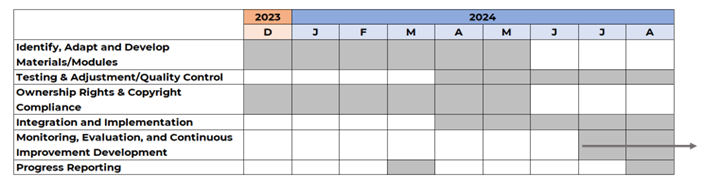

Expected Deliverables

  1. Identify, Adapt and Develop Materials/Modules

a.      Development of a minimum of 50 materials/modules covering:

                                                              i.      Proposed topics of Materials/Modules:

1)       Good Agricultural Practices (GAP)

2)     Disease Fighting

3)     Agroforestry

4)    Tapping Qualities

5)     Improving yields through approved rubber clones

6)     Others relevant topics addressing specific challenges faced by smallholders (subject to discussion and approval by the KSP Task Force)

                                                            ii.      Regional Coverage: Indonesia, Thailand, Côte d’Ivoire, Malaysia, Cambodia, Vietnam, Sri Lanka, Myanmar, Liberia, India, Brazil, Ghana

                                                          iii.      Languages:  Bahasa Indonesia, English, Thai, French, Khmer, Bahasa Malaysia, Vietnam, Sinhalese, Burmese, Spanish, Portuguese, Tamil

                                                          iv.      Format: text-based materials, audio-visual contents (such as movies, videos, animations, cartoons, infographics) and other suitable formats.

    1. Creation of a guidance document for users and a content inventory system for content managers, providing detailed information on modules/materials and relevant content resources. 
  1. Testing & Adjustment / Quality Control
    1. Submission of a quality control report on the developed modules/materials, inclusive of language localization and formatting testing to ensure adaptability for different regions.
    2. Implement feedback mechanisms allowing users to provide input on the content’s usefulness and effectiveness.
  1. Ownership Rights and Copyright Compliance

       Provide copyright/licensing documents demonstrating the rightful acquisition or development of materials/modules and registration of intellectual property rights with GPSNR.

  1. Integration and Implementation

       Demonstration of the complete integration and implementation of developed modules/materials into the KSP, ensuring accessibility and usability within the platform.

  1. Monitoring, Evaluation, and Continuous Improvement

       Collection and submit report on of data on user interactions, time spent on modules, user feedback, and other relevant usage statistics, along with lessons learned or findings. 

  1. Progress Reporting

       Submission of a mid-term report containing project summary, key milestones, module/materials development summary, quality control details, intellectual property rights information, challenges and recommendations.

       The final report and presentation will document the project’s process and outcomes, providing a roadmap for future Knowledge Sharing Platform enhancements.


Submission Guidelines & Requirements


The following submission guidelines & requirements apply to this Request for Proposal:

  1. Proposals will only be accepted from individuals or firms with experience relevant to this project. Examples of previous relevant work should be provided, as well as resumes of all key personnel performing the work. We welcome joint-organizations to submit proposals for this RFP.

  2. A detailed technical proposal must be provided. The technical proposal should include, but is not limited to, the following:

       A workplan that outlines proposed methodology to carry out all key activities stated above. Interested bidders are welcome to propose additional activities that are deemed important in ensuring successful executive of this project.

       Key outputs align with the expected deliverables stated above.

       Timeline and key operational stages.

       Price proposal (budget), detailing an overall fixed price and a breakdown of expected costs for manpower, logistics, and other project-related expenses.

       Description of past work and technical expertise that is relevant to this RFP.

       A list of project team members with their roles in the project and associated qualifications.

  1. Proposals must be signed by a representative that is authorised to commit the bidder’s company.

  2. Proposals must be received prior to the 24th November 2023 to be considered. Proposals should be submitted to cheewei@gpsnr.org for consideration.

  3. GPSNR reserves the right to amend the scope and budget of this RFP in order to get the most suitable consultant for each topic.


Project Timelines


RFP publication

8 November 2023

Submission deadline for proposals

24 November 2023


Evaluation of proposals and follow up

24 November – 7 December 2023

Contract Award and Notification to Unsuccessful Bidders

8 December 2023


Proposed Project commencement date

15 December 2023

Mid-term review

March 2024

Final review

August 2024

The above timeline is open to further adjustments based on discussions with the interested bidder(s) and GPSNR’s ongoing key milestones.


Budget

The Platform is anticipating that a total budget of no more than 80,000 EUR be allocated to this RFP.


The proposed payment terms are as follows:

       20% at the signing of the contract


       30% at the Mid-term Review (the date will be agreed upon and documented in the contract)

       50% on Final Review

These payment terms are subject to further adjustments based on discussions with the interested bidder(s) and the project timeline. 

Evaluation Factors

GPSNR will rate proposals based on the following factors, with cost being the most important factor:

1.        Responsiveness to the requirements set forth in this Request for Proposal

2.      Relevant past performance/ experience

3.      Samples of work

4.     Proposed price/budget

5.      Technical expertise/experience of bidder and bidder’s staff

6.      Proposed timeline


When evaluating bids, GPSNR may request for more information as part of a full due diligence to understand bidders’ technical and commercial background, assess potential conflicts of interests and independence vis-à-vis natural rubber smallholders and the wider agricultural sector, and level of competence for the project.

GPSNR reserves the right to award to the bidder that presents the best value to GPSNR as determined solely by GPSNR in its absolute discretion.

More To Explore

Request for Proposal – Oversight

FEBRUARY 2026 

ISSUED BY 
Global Platform for Sustainable Natural Rubber 

Introduction & Background 

The Global Platform for Sustainable Natural Rubber (GPSNR) is an international, multi-stakeholder, voluntary membership initiative seeking to lead improvements in the socioeconomic and environmental performance of the natural rubber value chain. Members of the platform include tire manufacturers, rubber suppliers and processors, vehicle makers and NGOs. Representatives from each of these stakeholder groups have contributed to the development of the Singapore-based platform and the wide-reaching set of priorities that will define strategy and objectives.

The GPSNR Assurance System, designed by Assurance Services International (ASI) and for GPSNR members, is a risk-based framework that supports credible and independent assurance processes. It enables companies to identify and mitigate human rights and environmental risks within their supply chains, undergo third-party verification, and report transparently on their progress through credible claims.

As part of its Assurance System, GPSNR operates an oversight mechanism to ensure that approved Assurance Service Providers (ASPs) deliver assessment and assurance services in conformity with GPSNR requirements. This oversight function is a critical component of maintaining the credibility, consistency, and integrity of the GPSNR Assurance System.

GPSNR is therefore seeking proposals from qualified and experienced individuals or organizations to provide GPSNR Oversight Assessor services in accordance with GPSNR oversight procedures and requirements.

The Engagement 

The GPSNR Secretariat is seeking one or more qualified Oversight Assessors to support GPSNR in planning, conducting, and reporting on oversight assessments of Assurance Service Providers. The selected provider(s) will support GPSNR in ensuring that ASPs continue to meet approval requirements and effectively implement GPSNR assurance procedures.

Scope of Work

The Oversight Assessor(s) shall perform oversight activities in line with the GPSNR Oversight Procedure. The scope of work may include, but is not limited to, the following activities:

Oversight Assessment Activities

  • Conduct 5-10 desk reviews of applicant or approved Assurance Service Providers, including review of documented procedures and records.
  • Conduct 5-10 office assessments (remote or on-site, as required) to evaluate conformity with GPSNR requirements and the effectiveness of ASP management systems.
  • Conduct 5-10 witness assessments by observing ASP assessors or assessor teams during GPSNR field assessments.
  • Apply appropriate oversight assessment techniques, including document review, interviews, and witnessing of audit activities.

Assessment Preparation and Planning

  • Support GPSNR Secretariat in defining the scope, type, and objectives of oversight assessments.
  • Prepare assessment agendas and support logistical planning as required.
  • Review background documentation prior to assessments, including previous oversight reports and ASP records.

Reporting and Follow-up

  • Identify, document, and grade nonconformities in accordance with GPSNR procedures.
  • Prepare clear, accurate, and well-justified oversight assessment reports.
  • Participate in opening and closing meetings with Assurance Service Providers.
  • Submit assessment reports to the GPSNR Secretariat for technical review within agreed timelines.
  • Support clarification or revision of reports where requested following technical review.

Professional and Ethical Requirements

  • Act in accordance with GPSNR assessment principles, including ethical conduct, impartiality, confidentiality, and due professional care.
  • Declare and manage conflicts of interest in line with GPSNR requirements.
  • Comply with all applicable health, safety, and confidentiality requirements during oversight activities.

Assessor Qualification and Competence Requirements

Proposals must demonstrate that the proposed Oversight Assessor(s) meet the following minimum requirements:

  • Relevant tertiary academic qualification in agriculture, environmental management, or a related field, or equivalent demonstrated professional experience.
  • At least three (3) years of professional experience in the management and/or delivery of certification or accreditation services.
  • Successful completion of a five-day ISO lead auditor training course based on ISO 19011.
  • Qualification as a lead auditor for the GPSNR programme or a comparable certification scheme in a related industry.
  • Successful completion (or commitment to complete) GPSNR-specific training on assurance procedures, assessment requirements, and relevant templates and tools.
  • Familiarity with GPSNR and the natural rubber industry

Submission Guidelines & Requirements

The following submission guidelines & requirements apply to this Request for Proposal:

  1. Proposals will only be accepted from individuals or organisations with experience relevant to this project.
  2. Examples of previous relevant work should be provided as well.
  3. A technical proposal must be provided that is not more than 4 pages. This technical proposal must include understanding of the assignment and proposed approach, indicative schedule and availability as well as resumes of all key personnel performing the work.
  4. A price proposal must be provided that is not more than 1 pages. This price proposal should indicate daily or hourly rates and an estimated number of days by activity.
  5. Proposals must be signed by a representative that is authorized to commit bidder’s company.
  6. Proposals must be received prior to the 20th of February to be considered. Proposals should be submitted to natalie.low@gpsnr.org for consideration.
  7. GPSNR reserves the right to amend the scope of this RFP in order to get the most suitable consultant.
  8. Bidders must ensure that all external personnel involved in preparing and executing this proposal are under exclusive agreements specific to this RFP. These agreements must obligate the external personnel to exclusively dedicate their services to the bidder’s proposal, prohibiting their engagement in any other proposals for the same RFP. This measure is to maintain the integrity of the bidding process and prevent conflicts of interest.

Project Timelines

Proposals submitted by consultant to natalie.low@gpsnr.org

February 20, 2026

Selection of Top Bidders / Notification to Unsuccessful Bidders

February 27, 2026

Contract start date

Tentatively March 2026

Budget

The Platform invites consultants to submit a competitive price proposal, and the proposed budget will be factored into selection of the consultant. The total contract value shall be calculated based on the daily rate and actual number of days worked per month. Invoicing shall be submitted on a monthly basis and must include a breakdown of days worked and activities performed for the relevant period.

Evaluation Factors

GPSNR will rate proposals based on the following factors:

  1. Responsiveness to the requirements set forth in this Request for Proposal
  2. Relevant past performance/ experience
  3. Cost and overall value for money
  4. Technical expertise/experience of bidder/bidder’s staff

GPSNR reserves the right to award to the bidder that presents the best value to GPSNR as determined solely by GPSNR in its absolute discretion.

Note: The award of this contract will only be considered complete upon completion of the contract signing.

Request For Proposal – GPSNR-RFP-C03-034-Polygon Mapping Malaysia

Introduction & Background

The Global Platform for Sustainable Natural Rubber (GPSNR) is an international, multi-stakeholder, voluntary membership initiative seeking to lead improvements in the socioeconomic and environmental performance of the natural rubber value chain. Members of the platform include tire manufacturers, rubber suppliers and processors, vehicle makers and NGOs. 


The Manufacturer’s Subgroup (SG) consists of GPSNR members who are rubber product manufacturers only.  The SG is seeking a consultant/field to map their supply shed (i.e., all the farms that they are sourcing from) focusing on polygon mapping techniques in complex supply chains such as in Indonesia, Malaysia and Thailand – each with a separate RFP, and report on the price and time required for each polygon mapped.

Objectives

The goal of the project is to investigate what effort (i.e., time and cost) may be required for a rubber processor to map their supply chain in complex supply chains in Malaysia. 

The consultant is to map small holder farmers in selected regions within Malaysia. Manufacturers will specify the regions to be mapped at a later date. 

The service provider should work with the Manufacturer’s Subgroup and the participating processors from Malaysia and their dealers to:


  1. Keep track of the time and costs of all mapping related activities throughout the study, calculate time and cost of mapping each polygon, and provide them to their GPSNR Point of Contact at the end of the survey.

  2. Register farmers using a provided data logger application. The service provider is welcomed to use their own data logger application. 


Scope of Work/Expected Deliverables

Specifically, GPSNR expects the consultant to:

  1. Map regions of rubber producers supplying to the participating processor in Malaysia via polygon mapping. 

    1. Single GPS coordinates should not be utilised irrespective of the size of the plantation. 

    2. Geo mapping to include coordinates up to 6 decimal places in geoJSON format 

    1. Store/transfer geo location polygons mapped, to a 3rd party database as designated. 

    2. Bi-weekly progress reports 

    3. Ensure compliance to applicable local and global data privacy norms and regulations such as but not limited to GDPR, PDPA, etc.

  1. We would like a detailed account of the resources: 

    1. Price per polygon mapped – Cost per unit (per Farmer/Plot/Polygon) 

    2. Timeline to map Polygons per day (eg 18 months to map X polygons)

  1. A recommendation of the scalability of this pilot

    1. Can the same estimated cost/time/labour be replicated in other regions/jurisdictions within the same country?

    2. E.g., $X/farm is calculated but is not scalable due to what reason(s).

  2. Interested parties should submit the quote for the following – 

    1. For mapping polygons (cost per Ha)

    2. For mapping polygons + completing set of questionnaires as a part of risk assessment

  3. Comply with applicable data privacy norms and regulations (including but not limited to GDPR and PDPA).

  4. An optional activity that service providers could provide is the ability to integrate a transactional traceability function (own or 3rd party as designated)

Proposal Format and Contents

The proposal should include the following:


  1. A workplan that outlines the key activities towards the deliverables outlined in Expected Deliverables above

  2. The timeline and key stages of operations based on Project Timeline below 

  3. Budget, including detailed breakdown of expected manpower, logistics, and costs as mentioned above

  4. Description of past work and technical expertise that is relevant to this RFP

A list of project team members with their roles in the project and associated qualifications.

Submission Guidelines & Requirements 

The following submission guidelines & requirements apply to this Request for Proposal: 


  1. Proposals will only be accepted from individuals or firms with experience relevant to this project. 

  2. Examples of previous relevant work should be provided. 

  3. A technical proposal must be provided that is not more than 4 pages. This technical proposal must provide an overview of the proposed solution as well as resumes of all key personnel performing the work. In addition, the technical proposal should provide a proposed schedule and milestones, as applicable. 

  4. A price proposal must be provided that is not more than 1 pages. This price proposal should indicate the overall fixed price for the project as well as hourly rates and an estimated total number of days. 

  5. Proposals must be signed by a representative that is authorized to commit bidder’s company. 

  6. Proposals must be received prior to the 25th of September to be considered. Proposals should be submitted to stefano.savi@gpsnr.org and aidan@gpsnr.org for consideration. 

  7. GPSNR reserves the right to amend the scope and budget of this RFP in order to get the most suitable consultant for each topic. 

Project Timelines


RFP Published

4 Sep 2023

Proposal Submission Deadline

25 Sep 2023

Contract Awarded

9 Oct 2023

Initial methodology presentation and Q&A with subgroup

23 Oct 2023

Bi-weekly progress updates

23 Oct till project conclusion

Other milestones to be agreed upon during initial Q&A


Budget

The Platform is anticipating that a total budget of no more than 20USD/ha be allocated to this engagement and more competitive quotations will be favoured. 


Payment terms shall be:

  • 20% at the signing of the contract

  • 30% at the midpoint date to be agreed upon and memorialized in the contract based on the submitted work plan

  • 50% to be agreed based on mutually agreed milestones

The allocation of the payment shall be based on the net amount after travel expenses, if deemed necessary by both the consultant and Secretariat, are incurred and documented.

Evaluation Factors

GPSNR will rate proposals based on the following factors, with cost being the most important factor:

  1. Responsiveness to the requirements set forth in this Request for Proposal

  2. Relevant past performance/ experience

  3. Samples of work

  4. Cost, including an assessment of total cost of ownership

  5. Technical expertise/experience of bidder and bidder’s staff


GPSNR reserves the right to award to the bidder that presents the best value to GPSNR as determined solely by GPSNR in its absolute discretion.


View RFP Document here

Translate »
Scroll to Top