
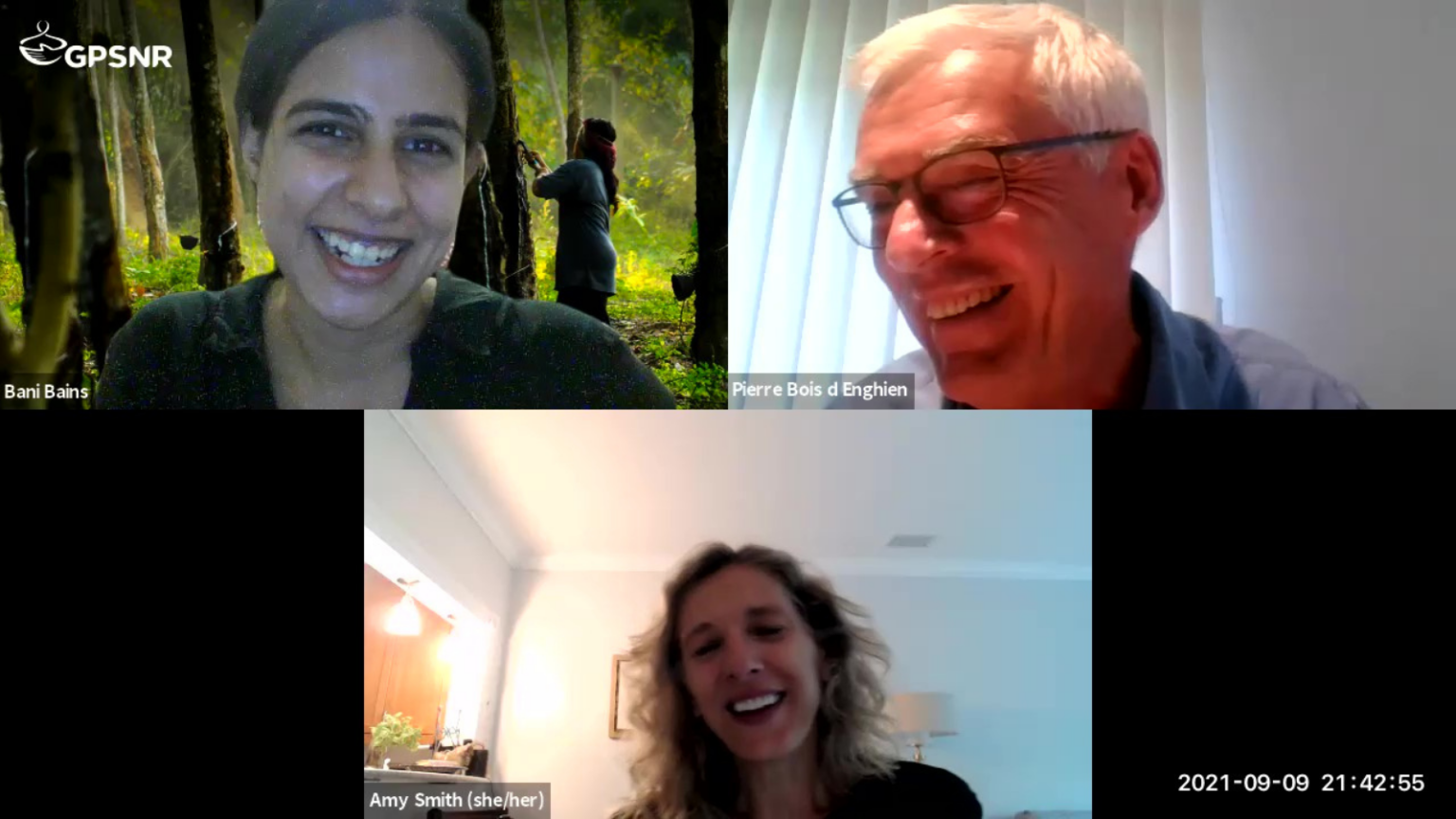
‘’Taking the first step even when you don’t see the entire staircase’’: Amy Smith and Pierre Bois d’Enghien talk about creating a Policy Framework for sustainability and equity in natural rubber
Bani Bains, Communications Manager, GPSNR
GPSNR offers a unique common ground, for peers to engage from across a complex supply chain. This makes it possible for us to have a more holistic perspective of each others’ challenges and aspirations for a sustainable and equitable natural rubber supply chain.
For Amy Smith and Pierre Bois d’Enghien, co-chairs of the Policy Toolbox and Implementation Guidance Working Group, the aspirations and challenges of all member categories became most apparent as they worked on putting together the GPSNR Policy Framework, which was adopted by the General Assembly in 2020. Today, all member companies must comply with the policy framework within six months of their membership into GPSNR.
As the first batch of member companies publish policies that are in line with the policy framework, Amy and Pierre had a conversation with me about the journey so far, and how the framework guides their current work around the development of different aspects of GPSNR’s assurance model.
BB: To start off, for anyone who isn’t familiar with GPSNR, could you very quickly tell us what the policy framework does and who it is for?
AS: The policy framework guides the company members at GPSNR with a common set of commitments for sustainable natural rubber. This aligns all categories in their pursuit of a sustainable supply chain and ensures we’re all headed in the same direction to uphold a specific set of environmental, social and economic values. The alignment is key in achieving GPSNR’s goals.
PB: The adoption of the policy framework across the supply chain also denotes a shared responsibility towards GPSNR’s objectives.
AS: Beyond these, there are also benefits for companies to have a policy. It can help companies to orient their actions to achieve sustainability, it can also help in engagement with their shareholders and in reflecting leadership. The next step after this, of course, is putting their policies into action, for which we are working on Implementation Guidance.
BB: If you were to go down memory lane, what was the process like of creating this policy framework from scratch? Is there any particular meeting or memory that stands out as an ‘aha’/goosebumps moment?
AS: We started with looking at the Accountability Framework for best practice guidance for developing a policy to develop the main elements of the framework: the policy components. With that in mind, we formed a drafters’ group which included some working group members including Pierre and myself, a representative from the Accountability Framework and two consultants. This group developed the first draft of the policy framework and then facilitated the incorporation of suggestions from other working group members.
What stands out for me is that it was a very, very long process – do you have anything in mind Pierre?
PB: Yes! Just to remind you, I joined the working group and the drafters’ group only in February 2020. By then, Amy and team had already taken care of a lot of work. But after I joined, I recall that it took us a long time to discuss all the components of the policy framework. Each word, each sentence, each idea had very important outcomes linked to them. It was a big feat to reach consensus, and sometimes that meant compromise among civil society and industry members. I think it took us almost one year to decide on the 37 components of the policy framework.
AS: Yes, there was painstaking detail to choose every word in the framework, and several rounds of consultation. Another challenge was the fact that we couldn’t have face to face meetings – and so reaching consensus took even longer than what we expected.
PB: Do you know the 80:20 rule? 80% of the work was completed before I joined, but the final 20% took 90% of the time. And even now, some of the language may need to be tweaked, especially as companies are now adopting these policies and are looking to move into implementation.
BB: Was the framework designed to be a ‘do no harm framework’ covering the minimum requirements from companies, or was it meant to go above and beyond that?
AS: I would consider legality as the minimum for companies to be complying with, but the actions proposed in the policy framework take quite a bit of work and go well beyond that.
Rubber supply chains are very complex, and getting visibility on the ground can be daunting, but it isn’t impossible. And that’s what civil society players are stressing upon: the fact that you need to have transparency on the ground.
BB: And was that a point of contention during the discussions leading up to the policy framework?
AS: We did a lot of discussion around clauses 7.1 and 7.2, and how to deal with the fact that the majority of rubber comes from smallholders.
I think there is another piece to this puzzle – which is that the processors, who are going to be doing a majority of the work, want some assurance from the downstream, that they’re going to be supported financially and technically in doing that work.
PB: Each conversation had a watermark of a significant question: who is going to pay for externalities? While we don’t have answers to some of these questions even now, the policy framework as it stands serves as a good starting point in a continuously evolving, complex but very exciting process.
BB: Did either of you have any non-negotiables in the policy framework that you would have not compromised on?
AS: Ah, yes! The commitment to no deforestation and having a cut-off date was important, because without that you can never define what deforestation is. We spent a lot of time on these points. And then there are others, like the commitment to human rights and free, prior and informed consent (FPIC), which we would have insisted on – but we didn’t have to because they were included straight away.
That alignment always existed across the board, because we are all committed to the principles of GPSNR. Nobody was saying those parts of the framework shouldn’t be there, though how they were framed was debated at length. This is because that would directly inform the implementation.
PB: From my side, the one non-negotiable was to use the HCV and HCS approach as the only tool to implement the zero deforestation policy. It was globally agreed among the members, but we were very cautious about the words.
BB: What can companies that have adopted the policy framework do before the implementation guidance is developed?
AS: There are several companies that have been active in this space for years now. And they’ve been contributing to the various working groups in applying their on ground knowledge to the requirements and tools. Beyond that, doing everything they can to achieve supply chain transparency is critical to be able to prioritize areas for action and to make any eventual claims about rubber’s sustainability. You can’t have sustainability unless you know the origin of your raw material. Companies can also refer to the Accountability Framework’s operational guidance for support regarding how to put their policies into practice while GPSNR’s Implementation Guidance is being finalized.
PB: They might know more than they think they do! When I start to write a sustainability report for a company, they don’t always have all the data or figures in one place. Most of the time, they have the information, but sometimes don’t know where to find it.
BB: If you had the opportunity to say something to members who may still be hesitant to comply with the policy framework, what would you say?
PB: I can understand fears around implementation and commitment to some components for members who are quite far from the field. But, we still have to find a commitment to reach the desired state. The policy is simply a part of the journey to sustainability, as are the challenges. We are not looking to blame anyone for non-compliance, but encourage intention to comply. So, just be fair, be honest, and do your best. And if you find some challenges in the implementation, bring them to us.
AS: The benefits of having a policy are numerous, including but not limited to: sending a signal internally and externally that the issues covered by the policy are important to the company and that resources and capacity will be dedicated to its implementation; providing clarity on a company’s goals and facilitating the roll-out of company commitments to suppliers upstream and buyers downstream; enabling the effective monitoring and measuring of progress; and supporting a company’s compliance with existing and emerging legislation on avoiding deforestation and upholding human and labor rights.
I think there is a misunderstanding that after a policy is adopted, companies have to be in full compliance with it from day one. That’s not a realistic expectation for any company; first companies need to understand where they are at as a baseline and from there, they will need to demonstrate continuous improvement. As responsible GPSNR members, companies will have to submit their action plans that outline how they will implement the different parts of their policies. They will also track progress and show continuous improvement through submission of annual reporting to GPSNR. The working group is currently developing the tools they’ll need to do this – the Implementation Guidance that’s designed to help orient companies on their sustainability journey, and the reporting requirements that are a key element of GPSNR’s assurance model. We still have a lot of work to do to finalize these two bodies of work, but fortunately, the Policy Framework provides a solid foundation from which to develop them.
In a complex supply chain historically burdened by social, economic and environmental inequality, the policy framework Pierre and Amy speak of serves as a guiding document for a hopeful future. As GPSNR members take this first step, even though the entire staircase isn’t fully visible just yet, their commitment towards transforming an entire supply chain is commendable.If you’re a GPSNR member looking for support around aligning with the policy framework, please reach out to us at info@gpsnr.org.