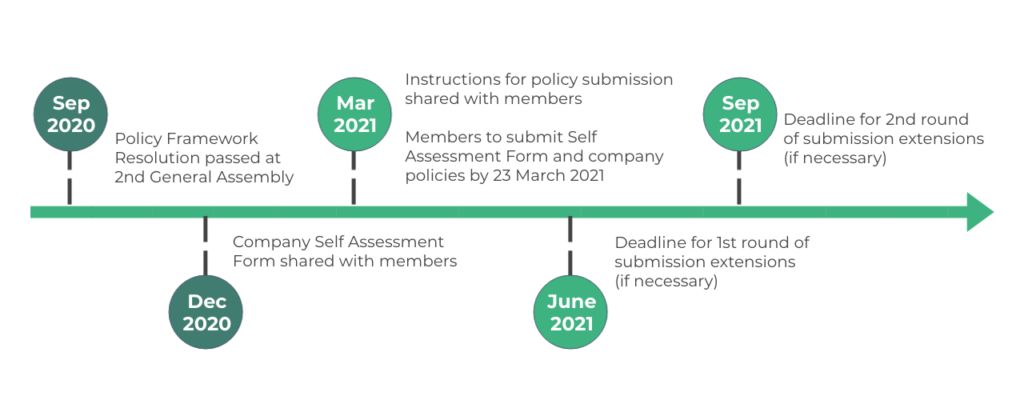


Member Consultation on proposed GPSNR Policy Components and Baseline Reporting Requirements (Members Version)

Share This Post

You must be logged in to view this content

More To Explore

News

The Road Ahead for GPSNR’s Working Groups

Strategy and Objectives Working Group

Moving forward, a key focus of the Strategy and Objectives Working Group is to look at increasing Working Group alignment within the Platform. Considering the interconnected nature of the work and the plan for Working Group-level Theories of Change, there is merit in bringing the Co-Chairs of Working Groups together to explore how to create better alignment. To this end, the Working Group is considering activities for the end of the year to build unity and alignment across all Working Groups.

The Working Group is also developing a procedure to assess external programs that are brought forward for GPSNR’s support, either by member organizations or by Working Groups. This process will involve evaluating the measurable Key Performance Indicators (KPIs) for the project and to what degree the project links to GPSNR’s Theory of Change. 

Under the Equity sub-Group, the Living Income Gap studies for Indonesia and Thailand are now underway following the award of the proposals to the selected bidders.  

Smallholder Representation Working Group

Prior to the General Assembly (GA), the Smallholder Representation Working Group had organised three international calls to prepare smallholders for the GA. A fourth international call will be held sometime mid-October. 

In the lead-up to this final international call, a round of national calls are being held with the help of the various Country Champions. During these national calls, smallholder members will be able to gather their thoughts around the GA, approved resolutions and Executive Committee election results, as well as to think collectively about the issues they would like to cover as a category during the international call, and, moving forward, the details of the engagement mechanism they wish to implement within the category.

Post-GA, the Smallholder Representation Working Group will explore how best to integrate members of the newest category into the various Working Groups. The Working Group is also looking at its exit strategy, having achieved the goals set out for it in its Terms of Reference document.   

‘Policy Toolbox’ Working Group

Following the approval of the proposed policy framework, a multi-stakeholder Technical Working Group will be set up to draft the Implementation Guidance for member companies. 

Concurrently, the Working Group will also develop a policy equivalent and implementation guidance for smallholder producers, and civil society.   

The Shared Responsibility Working Group, whose creation was approved by the Executive Committee, will be established to identify how the responsibilities and costs of implementing sustainable natural rubber initiatives can be more equitably distributed across stakeholder categories. It will help to inform the development of the Implementation Guidance, while bearing in mind that whatever requirements are defined for smallholder members, those members should not carry the burden of a higher cost to implement sustainability activities and comply with the Policy or Implementation Guidance to be developed.

‘Capacity Building’ Working Group

At the end of July 2020, the Capacity Building Working Group had presented finalized capacity building strategies for four selected countries, to the Executive Committee.

For its next steps, the Working Group will be developing implementation guidelines and an evaluation framework. This will be crucial in ensuring that the various capacity building activities are put in place in a concise and effective manner leading to the outcomes framed in GPSNR’s Theory of Change. The Working Group will continue to discuss the feasibility and find consensus on an approach that relates to carbon compensation schemes around natural rubber. 

Finally, the Working Group will also refine its group structure to better address the changing roles and responsibilities it now faces.

‘Traceability and Transparency’ Working Group

The Working Group has awarded the GIS Database and Mapping Tools study to the Zoological Society of London (ZSL), and the Traceability and Transparency Tools Comparison study to e-Audit Hong-Kong Limited (e-Audit). 

The studies are ongoing, and the Working Group will then use those studies to develop next steps as well as recommendations to the Executive Committee.

The Working Group will also be continuing conversations on risk-based approach methods to evaluating field-level legal, social and environmental risks.

News

Secretariat Update – October 2019

In attendance were farmers, processors, tire companies, apparel and footwear brands, NGOs and governmental representatives, all together over 100 participants. 

 The event offered a space for the diverse set of attendees to discuss the challenges and opportunities experienced by the rubber sector in the adoption and implementation of individual and global commitments to sustainable and ethical rubber with a focus on solutions. What set the workshop apart from the regular workshop we all know, was the addition of a field-excursion to two rubber-plantations operating under differing production models: a farm applying agro-forestry with a mix of native hardwoods and rubber trees and one fully developed diversified community agro-forestry farm. Additionally, instead of solely focusing on NGOs, companies and governmental representation (as the regular workshop often does), delegations from a number of farmer associations representing various countries also attended and provided key input to inform discussions from the farmer’s perspective.

Days 2 and 3 of the workshop were focused on forming partnerships and generating solutions to begin working towards a transformed natural rubber supply chain which delivers value to all actors from the farm to the end user.  Break out groups comprised of farmers, processors, brands, NGOs, tire companies and government representatives discussed topics such as traceability, policy implementation and capacity building for smallholders. Each break out group then categorized their discussions into short term actions, long term actions, barriers and learning curves which will be summarized into a collective call to action by the organizing team.  One of the most powerful outcomes was an overall agreement amongst all stakeholders in attendance that to truly bring about positive transformation we must all work together towards a shared vision.

A public summary of the event will be shared in the coming days, please contact Samantha Morrissey (smorrissey@ra.org) or Margaret Kran-Annexstein (margaret@mightyearth.org) with any questions.

Translate »
Scroll to Top